
History Beyond the Central Plains' Gaze
The real colonizers were not foreign nations, but the Central Plains' culture, which self-deprecates and misunderstands Manchuria. The article emphasizes that Manchuria's history and civilization were not 'backward,' but rather ignored in the Central Plains' historical narrative. By re-examining the history and economy of Northeast Asia, it reveals the importance of multicultural exchange and independent development.
It has long been said that Manchuria has been severely colonized, and I would say, yes. However, the colonizer is neither Japan nor Russia. One only needs to see how Manchurians infinitely self-deprecate in front of whom to know who colonized Manchuria and did so very successfully. For a long time, the colonizers in Manchuria have generally viewed themselves as disseminators of advanced civilization and as the natural leaders of Manchuria. On this basis, many outsiders from the other side of Shanhaiguan (山海关) defend their one-way resource extraction during their expansion as having a systemic development purpose. They continuously implant the false concept of Manchuria being “backward” because the systematic spread of advanced civilization to backward regions and societies through colonial rule is considered one of the important sources of legitimacy for imperialism. But in fact, we were never truly backward.
In the writings of the Central Plains, the ancient history of our homeland is depicted as tribal skirmishes, an arrogance that has almost run through the entire history of the Central Plains. But China is not the only country in the world with history; in numerous historical materials from outside the region, we are able to glimpse our original appearance. And even the Central Plains historical materials are far from flawless, with genuine information leaking between the lines that helps complete the truth about our ancient history.
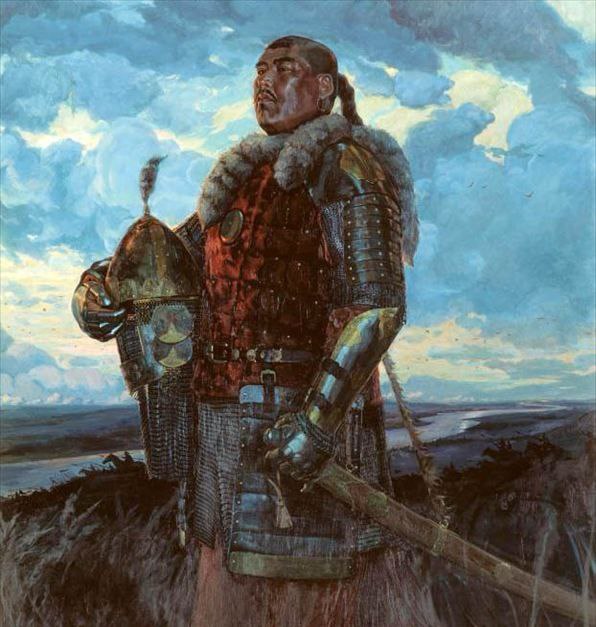
Since the 14th century, with the great Yuan losing its rule in China, new nations arose from Southern China, allowing the Northeast Asian continent to regain its freedom. This hard-won freedom enabled most of Northeast Asia, except for Korea, to enter the feudal era, an era centered on the fiefdom system, lord system, and contract system. On one estate (Tokso) after another were the knightly class who owed military service to the lords; in that era, they were called “Pijiaren” (Uksin, literally ‘armored men’). Regarding royal power, it was also from this era that the monarchs of the Hulun Four Nations formed an alliance with an election-of-the-Khan system and expanded the Khanate’s administrative circle to the East Sea coast, the area now called the “Primorsky Krai.” The monarchs did not enjoy their power exclusively; there were Councils of Sages in these nations. The state’s public officials (Jusedeute), the large and small lords (Hafan), and the Lamas who held fiefs all fought for their rights in the council, just as the monarchs did before the Khan of the Khanate. Outside the council was the system of monarchical advisors, which was called the “Jarguci.” This system also originated from the Hulun Alliance of the feudal society. It was the secret assembly belonging to the royal power, checking and balancing the state’s Council of Sages. And at the most grassroots level, thanks to Russian documentation, we know that there were customary law and spontaneous tribunals. When a case occurred, scholars familiar with customary law were selected to participate in the trial. On the day of the trial, people first divided into small groups to discuss the case, then the court opened, and people sat in a circle. After the plaintiff and defendant spoke, witnesses were questioned, and then attendees were allowed to speak extemporaneously. The verdict was made collectively by the attendees. All of this is very familiar; it is very close to the modern jury system.
In terms of economy, contrary to the stereotype, foreign trade was the most core activity, not the fishing, hunting, and gathering of the so-called tribes as written by the Central Plains people. A nation at the time could not do without fishermen and hunters, but the maintenance of the state could not rely on this. Furs, ginseng, honey—endless goods needed to be dumped abroad through merchant groups, traveling to the marketplaces of Northern Yuan, the residences in Hanseong, and even the streets of Jiangnan. Business was not always smooth, so there was war. If the Jurchen armed merchant groups lost, there was punishment, such as the Dinghai Campaign, which was called “Liting Saoxue” (犁庭扫穴, ‘plow the court and sweep the caves’). Although only a few towns were burned and some women and children were abused before they “returned triumphantly because the accumulated snow was several feet deep, the cold wind was splitting the skin, and they could not stay long.” This did not prevent it from being listed as a great military achievement in the Central Plains’ writings. And even if the Jurchens won, they would not be treated as equals by the arrogant Central Plains dynasty. Talk about reopening border trade, free transactions, and the like will always be jarring under the Celestial Dynasty (Tianchao) order. Perhaps they would ultimately still open up border trade, but in the books, it would be written as “backward tribes once again looted the border pass.” Just as they did two thousand years ago, they have never changed this tradition.
Relevant Researchers:
- Тураев•Борис• Александрович
- В•А•Никонов
- •ÕМаргаритов
- А•П•Деревянко
- И•А•Николаевич
If you think the article is good, please forward and share it.
If you have good ideas, please contribute!
Feel free to reward the author!
Your encouragement is our greatest motivation to move forward.

USDT/C(TRON)

ETH
USDT/C(TRON): TGmKX2fHbcqXxGU5KFyU4PeARjkyumyYbH
ETH: 0x699A6Fa5F4ABa8B5214C6BA564CD0Da6B8122697