The Tears of the Remaining People Exhausted in the Siege: The Manchu Elegy in the Siege of Changchun
Changchun, more than seventy years ago, witnessed one of the most tragic, yet deliberately forgotten, scenes in modern Chinese history. In 1948, amidst the political struggle between the Kuomintang (KMT) and the Chinese Communist Party (CCP), this former capital of Manchukuo became a true dead city. Hundreds of thousands of **Manchurians** starved to death during the siege. They were neither the compatriots to be saved in the eyes of the KMT nor the people to be liberated in the words of the CCP. They were merely chips to be sacrificed as two Southern regimes fought for control of the nation.
The 1948 Siege of Changchun was the most brutal, most inhumane, and the most tacitly understood yet most deeply suppressed event of the Chinese Civil War. It was not merely a tactical victory of ‘sieging without attacking’; it was a political massacre that used civilians as bargaining chips. In this war, jointly dominated by two political forces from within the Great Wall (关内 - guan nei, remaining untranslated), the Manchurians, especially the citizens of Changchun, became the most thorough and silent victims. Three years after the collapse of Manchukuo, the citizens of the former capital of Changchun truly experienced the feeling of being ‘stateless slaves’ (wang guo nu - remaining untranslated). The tragedy of Changchun was neither an accident nor a ‘collateral damage’ in the liberation of the entire nation. It was the direct product of the two parties vying for power, a cold calculation by the Southern regimes to sacrifice Manchurians and destroy Manchuria in their struggle for control of the region. In the victory of this political and military contest, Manchurians had no choice, only fate. Whether it was the KMT or the CCP, from the first day they entered Manchuria, they never truly regarded Manchurians as people to be won over. Both parties came from within the Great Wall (关内 - guan nei, remaining untranslated) and treated this land as a stepping stone and a chip for imperial power. The tragedy of Changchun was the ultimate manifestation of this logic.
I. Flesh and Blood Behind the Numbers
According to the Central Daily News reported on October 24, 1948: “According to the lowest estimate, the bodies of men, women, and children piled up in the fields around Changchun’s Communist front line totaled no less than 150,000 between late June and early October.” This number does not even include the residents who starved to death inside the city. According to the memoirs of the former KMT mayor of Changchun, Shang Chuandao (尚传道 - remaining untranslated), and the cited source Snow White, Blood Red (雪白血红 - remaining untranslated), the CCP’s preliminary official statistics suggest about 120,000 people starved or died of illness. However, according to the Changchun City Gazetteer, the city’s population in the first half of 1948 was 611,246, and only 179,241 remained at the time of the ‘liberation.’ Even accounting for some refugees escaping, nearly 300,000 people remain unaccounted for. AP reporter Du Bin (杜斌 - remaining untranslated), based on his ten-year investigation, arrived at an even more horrifying figure: the death toll from starvation should be between 370,000 and 460,000. Lung Ying-tai (龙应台 - remaining untranslated) estimated the death toll might be as high as 650,000, believing Changchun’s wartime population may have been close to one million. From Snow White, Blood Red (雪白血红 - remaining untranslated) to The Changchun Starvation War (长春饿殍战 - remaining untranslated), numerous survivor recollections reveal that the living conditions in Changchun at the time were comparable to hell. Food prices skyrocketed, and the legal tender (法币 - fa bi, remaining untranslated) depreciated so much that a gold ring couldn’t buy a single piece of sorghum cake. People stripped tree bark, chewed on grass roots, ate ‘Guan Yin Soil’ (观音土 - remaining untranslated, a type of clay), and even boiled leather and paper pulp into soup. Wooden furniture was dismantled, telephone poles were cut down, and the grass and bark on the green spaces were scraped clean—everything that could burn or be eaten was consumed. Bodies were left uncollected, epidemics raged, wild dogs tore at the remains, and there were even reports of human flesh being sold on the black market. One life after another was utterly exhausted in the cold calculations of the KMT and CCP armies. This was not a city’s war; this was a “silent massacre.”
II. Atrocities by Both Parties: Neither was the “Liberator” of the Manchurians
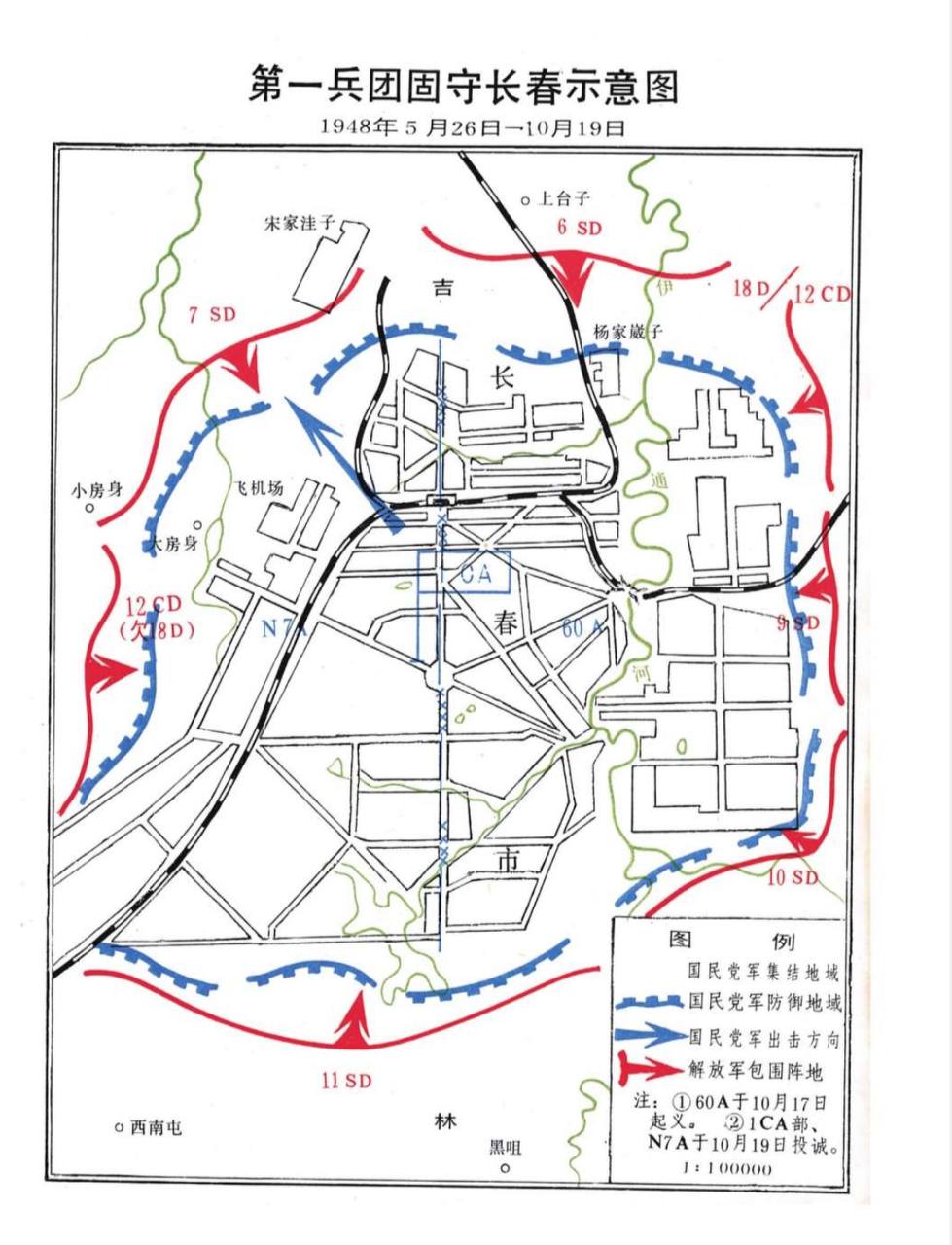
The creators of this catastrophe were not limited to one side. In the Siege of Changchun, both the KMT and the CCP, each in their own way, subjected the Manchurians to ruthless exploitation, harm, and abandonment. They both prioritized military objectives, viewing the populace as obstacles, burdens, and even as expendable tools. The actions of the Changchun defenders were a microcosm of the KMT regime’s ruthless treatment of regions outside its core support base. Under the orders of Chen Cheng (陈诚 - remaining untranslated), Director of the Northeast Headquarters, and Wei Lihuang (卫立煌 - remaining untranslated), Commander-in-Chief of the Bandit Suppression Headquarters, the defending army adopted a policy of “better to starve to death than surrender.” This sounded courageous, but the implication was: Manchurians could die, but the Party-State’s regime could not be lost; Manchurians were the price the KMT was willing to pay at all costs. At the beginning of the campaign, the defenders immediately sealed off routes out of the city to prevent citizens from fleeing. One reason was to prevent “shaking military morale,” but the other was more cruel—the civilians were viewed as a burden, and keeping them inside the city made it easier to concentrate control and exploitation. Soon, the military began a combination of policies to ‘slaughter the civilians to feed the army’: under the guise of requisitioning, they plundered the civilians’ grain, ostensibly allowing them to “keep some rations,” but in reality, taking everything. They searched homes with cooking smoke, patrolled the roads for anyone transporting food, and even confronted anyone seen holding food, often beating them, and arresting anyone who dared to resist. On June 28th, thousands of citizens looted a grain depot, and countless people were shot dead by the defenders in what became known as the “Concordia Hall Bloodshed” (康德会馆血案 - remaining untranslated). Later, after supplies were completely cut off, Chiang Kai-shek ordered the complete confiscation of all civilian property and grain, followed by the expulsion of citizens under the pretense of “issuing grain.” Many civilians were tricked into going to the checkpoints, had all their food rations confiscated, and were then driven out by military police, without clothing or food, left to fend for themselves in the wilderness. The KMT was not “incompetent,” but rather cold-blooded—they knew there wasn’t enough food, so they treated the civilians as food-consuming units, driving them one by one to the death line with gun barrels and lies. And when the starving corpses were everywhere and the stench of decay filled the air, they blamed everything on the Communist blockade and the harshness of the war, as if they were just innocent, pathetic executors of orders, slyly disguising themselves with the banality of evil. In reality, they were the closest blade to the throats of the Manchurians. Meanwhile, the CCP’s “strategic wisdom” of besieging without attacking was a complete moral failure. In May 1948, Lin Biao (林彪 - remaining untranslated) proposed “encircling without engaging” and personally signed the order to “turn Changchun into a dead city.” With no overwhelming advantage in troop strength, they used starvation, blockade, and terror as weapons to induce collapse within the city. They knew this would cause a large number of civilian deaths, yet they still chose it as a means to victory. The Liberation Army constructed multiple layers of blockade lines around Changchun—barbed wire, trenches, and dense sentries, one every 50 meters—creating a perfect death barrier, a meticulously woven shura field (xiu luo chang - remaining untranslated) to trap and starve the citizens of Changchun. When the KMT troops began to expel the civilians, the Liberation Army tacitly issued strict orders not to let them through, even carrying out “ideological education” to persuade the dying women, children, and elderly to turn back. Tens of thousands of Manchurians were thus caught in the vacuum between the two armies, where the hope for life and the humanity of both the KMT and the CCP were absent. During this visible process of death, the Liberation Army only began conditional, small-scale releases in August, but repeatedly emphasized not to release too many, lest enemy spies infiltrate. They even strictly screened those released: workers were allowed, but the old and weak were discouraged. This precisely calculated distribution of death was a strategic consumption of human life. Some units even opened fire on civilians attempting to flee, literally turning “liberation” into a massacre. After the war, however, the CCP hailed this campaign as a “bloodless victory,” packaging itself as a symbol of “benevolent governance” (仁政 - ren zheng, remaining untranslated), shifting all blame to the KMT, and concealing its meticulously designed, systematic starvation siege strategy. The Communist Party ultimately “peacefully liberated” Changchun in a manner of “subduing the enemy without fighting,” but this victory was built upon the deaths of over a hundred thousand Manchurians. They loudly proclaimed a government for the people, yet before even gaining power, they allowed the people to become the earliest sacrifices.
III. The Liberated Manchurians, the Fate of Stateless Slaves
The tragedy of the Siege of Changchun is a microcosm of the colonization and plunder of the Manchurian lands by the KMT and CCP in their struggle for control of China. Since the collapse of Manchukuo in 1945, the fate of the Manchurians has been tied to an uncertain historical turning wheel. They transitioned from minor players in the international poker game of the past to small-suit cards in the hands of others, losing the right to bargain with major powers. The dismantling, acceptance, and reorganization of the former Manchukuo forces by both parties stripped Manchurians of their right to struggle; henceforth, they were the fish, and others were the chopping board. During the siege, the lives, grain, residences, and even the number of casualties of the Manchurians were chips and tools on the bargaining table of the high-level political game between the two parties. To this day, when the matter is discussed, both sides either remain silent or point fingers at the other. It is said that the one who wins the hearts of the people wins the world, yet under the mirrored tyranny of the two parties—where Manchurians were searched for food, driven out, imprisoned, shot, and starved to death—public support had long been obliterated. After the war, the propaganda of a “bloodless victory” covered up all this bloodshed and tears, simply using the glory of triumph to suppress the groans of hundreds of thousands of the dead. Manchurians continue to bear the bitter fruit of being a defeated nation of World War II.
IV. Manchurians Are Still Waiting for Justice
Today, while literati on both sides of the strait are still shifting blame, and historians debate the veracity of the death toll, Manchuria, this repeatedly crushed land, remains silent. The memory that belongs to Manchuria has been silenced in its subjects. The voices expressed by Manchurians, whether supporting or opposing the regime, seem to have fallen into a new Siege of Changchun. The rigidity and coldness of the KMT and the cunning and calculation of the CCP have jointly etched scars on the Manchurians, and now they are sometimes opposed, sometimes cooperative, as if nothing ever happened in Changchun. It makes sense, really—they were outsiders, so how could they care for the surrounding lives when slaughtering? They were the “remnants of the ‘puppet Manchukuo’ of the former dynasty” (伪满余孽 - wei man yu nie, remaining untranslated), so how could they be soft-hearted when acting? They were a colony descended from the heavens, so what would it matter if it were destroyed? For Manchuria, the two parties either stumbled here or celebrated a triumphal return. The losers left shamefully, while the victors, swept up in the people’s acclaim, established monument after monument for themselves. Beneath these monuments, however, lie the souls of countless Manchurians, waiting for justice amidst sighs and groans. The Siege of Changchun tore open the ugliest page of the KMT-CCP Civil War. It was not a symbol of victory, but a failed test of humanity. Manchurians had no right to participate in the war, yet they bore the heaviest price. History must not forget any of this. The Manchurian land is still waiting for a reckoning and respect.
If you think the article is good, please forward and share it.
If you have good ideas, please contribute!
Feel free to reward the author!
Your encouragement is our greatest motivation to move forward.

ETH
ETH: 0x0155713eFf177333849cC63a19645675a1E13882