The Xinhai Anti-Manchu Campaign: China's Fascist, Inhumane Ethnic Cleansing

Zorro
Club leader and Editor-in-chief.
Recently, China celebrated its 'Double Tenth National Day.' China set its National Day on October 10th to commemorate the start of the 'Wuchang Uprising' in 1911, aiming to celebrate the 'revolutionary victory' of overthrowing the Qing rule and establishing the 'Republic of China' regime. However, was the Wuchang Uprising in 1911 truly a glorious and righteous revolutionary movement?
Recently, China celebrated its “Double Tenth National Day.” China set its National Day on October 10th to commemorate the start of the “Wuchang Uprising” in 1911, aiming to celebrate the “revolutionary victory” of overthrowing the Qing rule and establishing the “Republic of China” regime. However, was the Wuchang Uprising in 1911 truly a glorious and righteous revolutionary movement? Perhaps from the perspective of Chinese fascists, it was, but from the standpoint of the Manchu nation, the essence of this “revolution” was massacre and riot. Neither the Kuomintang nor the Chinese Communist Party mentions the atrocities committed during this event. In fact, they still use the banner of “liberating the Chinese nation” and romanticize it in their national education textbooks as a righteous anti-feudal struggle.
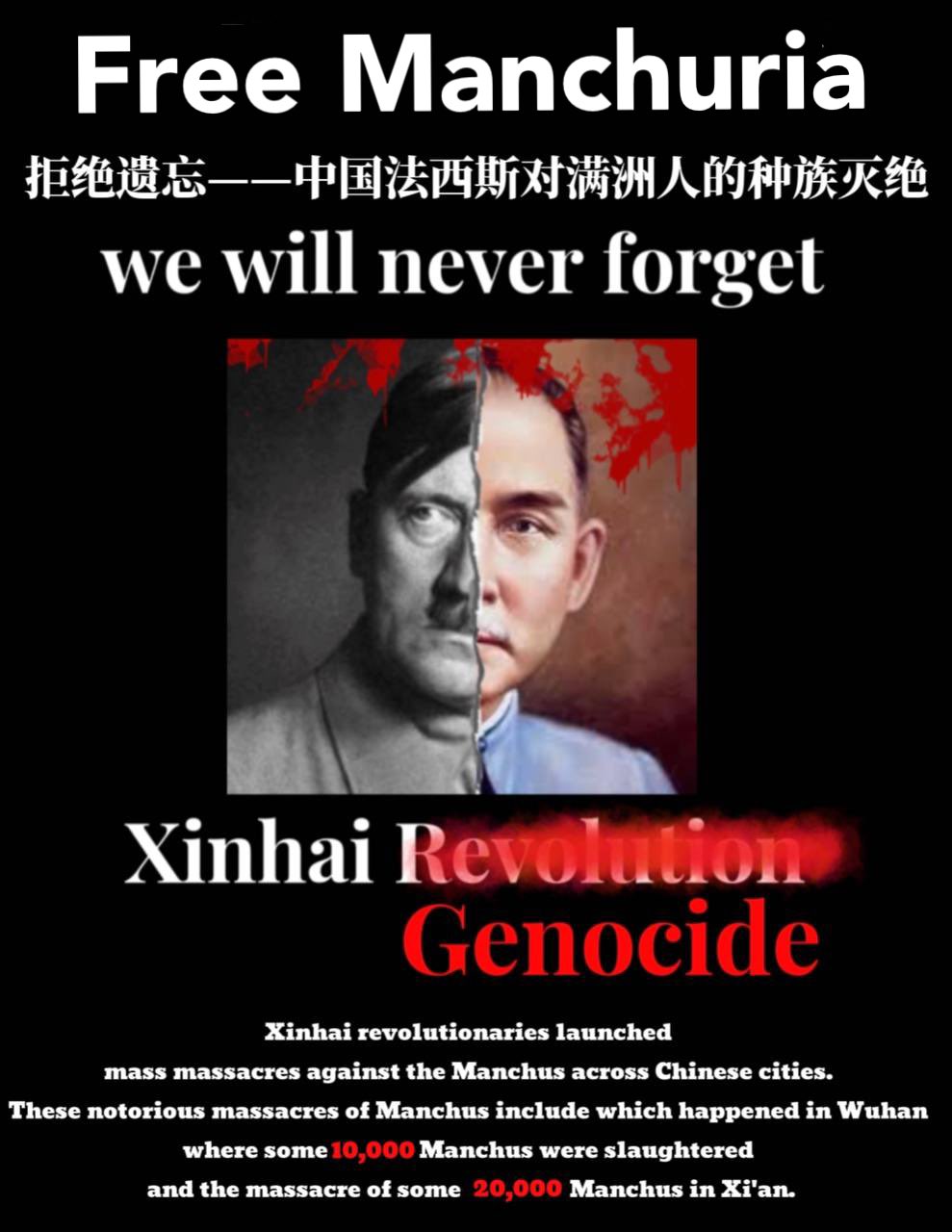
Clearly, the truth is otherwise; the “Xinhai Revolution” was essentially a bloody and horrific massacre and ethnic cleansing.
Li Youxin, a veteran film critic, has a grandmother who was a Nanjing native. His grandmother witnessed the birth of the Republic of China. She recalled that when the revolutionaries entered Nanjing, they would count the number of people. If the count of “one, two, three, four, five, six” was pronounced with the Jiangsu accent for the number “six,” they were Chinese, and they would be spared. Those with a northern accent were uniformly judged to be Manchurians, resulting in an immediate beheading.
From the perspective of the international community, this anti-Manchu riot was also a complete act of genocide. Joseph W. Esherick, a renowned American Sinologist and Professor of Modern Chinese History at the University of California, San Diego, offered this view on the Xinhai Revolution: “It was pretty much a massacre… If the bannermen were killed because they were a potential danger, then the killing of women and children seems utterly unnecessary.”
The British missionary Timothy Richard, in his memoir “Forty-Five Years in Late Qing China,” also wrote: “On October 22, 1911, a terrible bloodshed erupted in Xi’an, the capital of Shaanxi, where fifteen thousand Manchus (men, women, and children alike were slaughtered).” The revolutionaries in Shaanxi later admitted that after conquering the Manchu city in Xi’an, fighting teams split into small groups to search from alley to alley and courtyard to courtyard. During this time, some soldiers and unit leaders killed bannermen and their family members who did not need to be killed.
Another British missionary named Kate also experienced the tragic situation in Xi’an.
After the Manchu city of Xi’an was breached, the revolutionary army rushed in, and regardless of age, gender, or even small children, everyone was killed. Houses were looted and burned. Those who hoped to hide from the storm were eventually forced to reveal themselves. The revolutionary army started a ruthless fire behind a low wall, incinerating the Manchu city. Manchurians who attempted to escape and enter the Han-inhabited town were cut down the moment they appeared at the gate.
Undoubtedly, the so-called “Xinhai Revolution” was a “revolution” fueled by Chinese nationalism, and the nationalistic views of the Chinese participating in it were no different from, or even more extreme than, those of fascists. Lü Zhongqiu, a revolutionary soldier who participated in the uprising, recalled that the Engineering Battalion, which first launched the revolt, had publicly agreed upon “Ten Articles of Prohibition” before the uprising, two of which were “Those who collude with Manchurians will be executed” and “Those who harbor Manchurians will be executed.” To prove the legitimacy of the revolution, the slaughter of the Manchu people during the Xinhai year was deliberately concealed for a long time.
Following the outbreak of the uprising, an incident occurred where revolutionary students from the Survey School attempted to kill their Manchu-bannerman classmate, Song Jing. They were stopped, but the reason for the intervention was fear that the bloody killing would frighten the students and prevent them from going out to join the revolution. According to the recollection of Lu Zuzhen, a revolutionary soldier in the 30th Battalion, each squad in their battalion (equivalent to a regiment) had one or two bannerman Qing soldiers. Before the revolution, comrades were assigned to deal with them. During the uprising, he and another revolutionary soldier, Liu Bingjun, were responsible for executing a bannerman named Shuang Bi. However, as he followed closely behind Shuang Bi, waiting for an opportunity to strike, “Chen Zuohuang, the section chief of my squad, seeing my hesitation, raised his rifle butt and violently struck Shuang Bi’s head. The intention was to kill him, but the rifle butt was slightly off to the left, and Shuang Bi tumbled down the stairs and bolted towards the First Battalion’s bannerman camp.”
Xiong Bingkun, one of the leaders of the Wuchang Uprising, recalled that the anti-Manchu violence peaked on the 12th. The slaughter that day was so horrifying that over a hundred gentry and merchants united to demand that the Hubei military government stop its soldiers from entering private residences to search for Manchurians. However, the military government refused, citing military necessity. It wasn’t until the 11 foreign consuls in Hankou intervened that the military government ordered a stop to the killings on the 13th. Although they were reluctant, they had to comply due to diplomatic considerations: it was very important for the great powers to remain neutral in this revolution.
A Reuters correspondent arrived in Wuchang on the 14th and “found Manchu bodies everywhere.” He estimated that eight hundred people had been killed, while a military government representative, after touring Wuchang, estimated that four to five hundred Manchurians were killed in the first three days after the uprising. Due to fears of contagious diseases, the victims’ bodies were buried.
The revolutionary Cao Yabo claimed that four hundred “Manchu soldiers” were killed and another three hundred were imprisoned. About one hundred were released in the spring of 1912, but ironically, seven of these bannermen were killed on their way back to Jingzhou due to being released too early. American historian Joseph W. Esherick believed that, for the Manchurians in Wuchang at the time, “it was a massacre.”
It is thus clear that the malicious nature of this riot is no less severe than other acts of genocide that occurred in other countries, such as the Armenian Genocide, the Rwandan Genocide, the Nazi ethnic cleansing of Jews, and the Soviet ethnic cleansing of Poles.
We mourn with heavy hearts for the Manchu compatriots who perished in the Xinhai Anti-Manchu Campaign. Their blood stained this land, and justice and dignity were ruthlessly trampled in the chaos. While Chinese fascists shamelessly raised the banner of “revolution,” tens of thousands of innocent Manchu people became the wronged souls under the knives of Chinese fascists. This atrocity was not only a cruel blow to the Manchu people but also a violation of humanity and civilization. As Manchurians living on the black soil outside the pass, we cannot allow the historical tragedy to be forgotten, nor can we ever let such a tragic event happen again in the future.
We hereby call on the international community to pay close attention to this incident.
There is no doubt that the independence and self-determination of the Manchu nation is the only way to prevent future tragedies. Should such a tragedy occur again, the victims would not only be the former residents of the banner cities but the entire population of present-day Manchuria who have become highly integrated and coexisting with the former bannermen.
History proves that only through genuine national self-determination can we break free from the shackles of history and regain our dignity and rights.
Finally, in our grief, we must learn from the past and transform our sorrow into strength to continuously fight for the cause of national self-determination.
May the souls of the deceased Manchu compatriots rest in peace. Let us remember history, and may our calls awaken more native Manchurians and people of conscience in the international community to the fate of Manchuria.
If you think the article is good, please forward and share it.
If you have good ideas, please contribute!
Feel free to reward the author!
Your encouragement is our greatest motivation to move forward.

ETH
ETH: 0xd2Eb2094D588970df88B21e5A4944B515112D618