
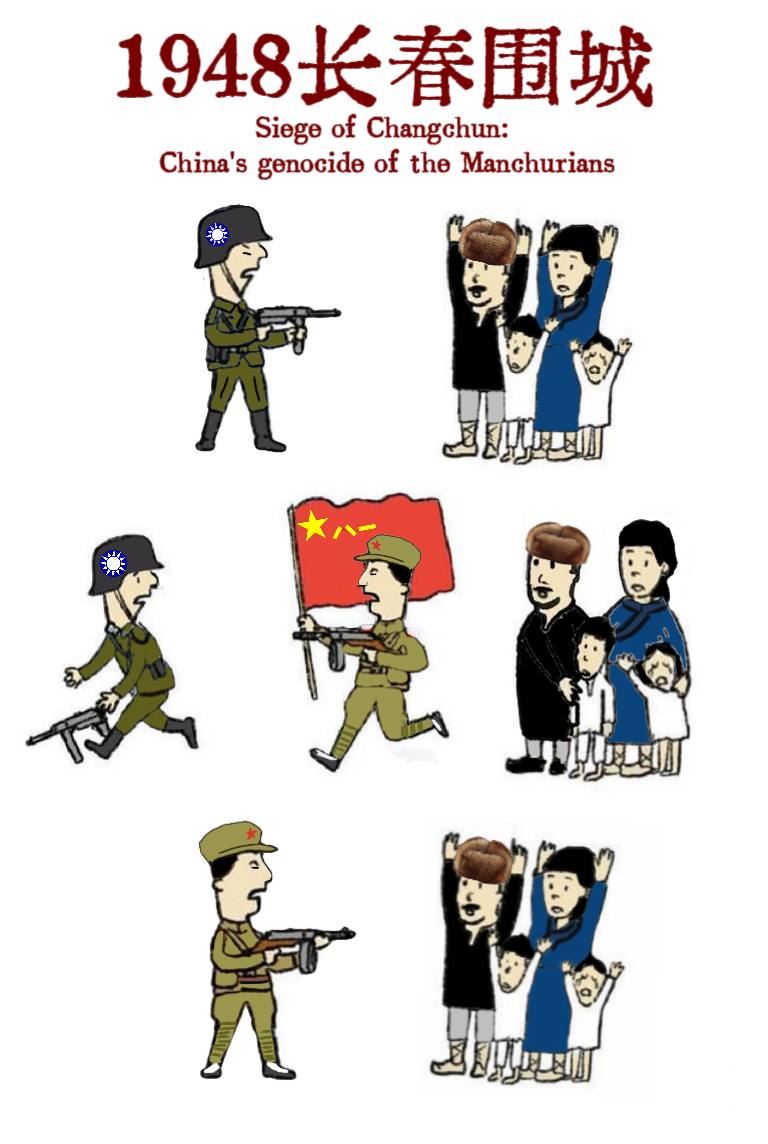
The Siege of Changchun: Blood Still Fresh — Can the Sons and Daughters of the White Mountains and Black Waters Remain Silent?

Black Soil Offcial
Self-reliance, self-confidence, self-governance, and freedom.
'The situation grew increasingly dire; more and more people in the city were starving to death. I personally saw several people lying by the roadside — one day they were there, and when I passed by the next day they were still there, their eyes wide open, their faces a purplish hue. That night a light rain fell, and I wondered where those people would take shelter. The next day, after the rain stopped, I passed that road again and saw them still lying there. Someone had kindly covered them with sacks, leaving only their heads visible. Each head and forehead had turned red and emitted a pungent stench — they had long since died.' — Excerpted from Mr. Shan Tianfang’s oral autobiography: 'Life Really Is One Word: Endure'
In 1948, an ordinary Manchurian family struggled to survive inside the besieged city of Changchun. The child of that family was Shan Tianfang — who would later become a master storyteller renowned for recounting great deeds.
But in that year his childhood was not a martial-arts saga; it was soaked in blood and tears, life and death.
Friends and relatives of the Shan family in Changchun were dying one by one of starvation. City residents tore strips from their own clothes to trade for a sip of water or a handful of beans. Corpses littered the streets, and the air reeked of rot and death. This was not fiction — this was the reality the people of the Manchuria endured.
All of this took place during what has been euphemistically called the “liberation of Changchun.”
Those who controlled the inland seats of power shamelessly whitewashed the event as a “liberation,” but the historical facts are horrifying: some 600,000 people were trapped inside the city, blockaded and cut off from food for five months. Under the guise of a “peaceful liberation,” more than 150,000 people starved to death — bodies everywhere, the land hushed. The brutal siege of Changchun left an abyssal wound on the land of the White Mountains and Black Waters. Tens of thousands of innocent civilians were starved to death under blockade. Yet in some histories the tragedy is downplayed as merely a “siege battle” in a civil conflict. That is not only an insult to the dead — it is a deliberate concealment of the truth. As sons and daughters of the White Mountains and Black Waters, we must recognize: the Siege of Changchun was not ordinary warfare — it was massacre; not “liberation,” but a naked atrocity against humanity.
How many still allow themselves to be fooled by the label “civil conflict”? How many still treat the Changchun siege as an unfortunate military necessity? We must ask: who used the lives of hundreds of thousands of Manchurian people as bargaining chips? Who, in the name of “unity,” enacted real bondage? The essence of the Siege of Changchun was a premeditated, organized campaign aimed at cleansing and plundering Manchurian people — a crime that amounted to ethnic extermination. It is further proof that inland imperial forces, amid brutal infighting over spoils, regarded the Manchuria as expendable.
These inland agents treated the Manchuria as a colony and the people of Changchun as an “other” to be exploited and sacrificed. It was the naked expression of their savage ambition.
We must understand that such horrors were rare when the people of the White Mountains and Black Waters enjoyed self-determination. History shows that only after the region’s sovereignty was taken away did the land become a chessboard for competing imperial forces. In the past we had our own industry and commerce, education, culture, even military autonomy. When inland agents seized control in the name of “unity,” what followed was the plundering of land and resources, control of economic lifelines, erosion of cultural identity — ultimately driving Manchurians into a humanitarian catastrophe. Resources were drained, power hollowed out, dignity trampled. The deaths in Changchun were not the inevitable costs of war; they were the consequence of losing sovereignty and becoming, in all but name, victims at the mercy of invaders.
Turning to the present-day Manchuria, those inland forces continue unremitting plunder and humiliation of this scarred land: population loss, hollowed-out industry, resource extraction, cultural marginalization. The evidence is clear — we are no longer the republic’s eldest son; we have become the autocratic state’s castoff. Behind this is a system led by coastal capitalists and aided by imperialist agents that systematically exploits and sidelines the people of the White Mountains and Black Waters.
When the wound of history has not yet healed, how can we allow them to rub salt into it with rhetoric? When a people’s dignity remains unreturned, how can they continue to bow and grovel to their oppressors? A nation without sovereignty has no voice; without voice there is no dignity, and without dignity there is no freedom or prosperity. The dead of Changchun bear witness to this truth with their bodies. If Manchurians today remain mesmerized by the false myth of a “unified China” and continue to accept marginalization, exploitation, and subjugation, history will mercilessly repeat itself.
These harsh historical facts keep reminding every Manchurian: the region’s future is not found in servility toward inland powers, but in rebuilding a sense of sovereignty, in cultivating regional pride, and in achieving political, economic, and cultural self-determination. Only by freeing ourselves from the systematic oppression of inland forces can we become self-reliant and strong.
We should remember our identity as the people of the White Mountains and Black Waters and engrave the blood and tears of the Siege of Changchun into our memory. National and personal grievances must not be forgotten; dignity and freedom must not be shaken.
The Manchuria must no longer be an empire’s granary or the stage for inland power struggles. What we need is a Manchuria that belongs to Manchurian people.
Let the victims of Changchun rest in peace, and let our black soil see the light again.
We must strengthen ourselves; the White Mountains and Black Waters must awaken! The blood debt of Changchun must never be forgotten; the future of the Manchuria must not be written by outsiders!
If you think the article is good, please forward and share it.
If you have good ideas, please contribute!
Feel free to reward the author!
Your encouragement is our greatest motivation to move forward.

ETH
ETH: 0xd2Eb2094D588970df88B21e5A4944B515112D618